You did the right thing.
You researched the options, read the reviews, and ordered the smartwatch with fall detection before you even left the hospital parking lot after your mother's first fall. You set it up, showed her how it worked, and finally — finally — felt like you could get through a full workday without that low hum of dread sitting behind everything you did.
We understand that feeling. And we also need to tell you what Margaret's family learned the hard way.
When Margaret's daughter bought her a smartwatch after her first fall, it felt like a solution. An extra pair of eyes. A silent safety net stretched beneath her 79-year-old mother's daily life. And for months, it worked — or at least it seemed to. Then Margaret slipped in the bathroom on a Tuesday morning and lay on the tile floor for two hours before her neighbor happened to stop by for a visit.
The watch never triggered an alert.
Margaret's story is not unusual. As fall detection technology has expanded from medical alert pendants to smartwatches and fitness trackers, millions of families have placed enormous trust in devices that — by the manufacturers' own admission — are imperfect. To be clear, technology has saved lives. But if we better understand where that technology falls short, we can use it smarter.
How fall detection actually works.
Most consumer fall detection devices use a combination of tiny sensors that measure movement, speed, and orientation. When the device detects a sudden sharp downward acceleration followed by a period of stillness — the signature of a fall — it triggers an alert, usually giving the wearer 30 to 60 seconds to cancel it before a call is placed to emergency services or a designated contact.
Some newer medical-grade devices mounted on the ceiling or wall use radar or computer vision rather than wearables entirely, eliminating the requirement that someone remember to put on a device. For families caring for a loved one with Alzheimer's or dementia, that distinction matters more than most product comparisons will tell you.
On paper, it seems great. In practice, it runs into the messy, unpredictable reality of how people — especially people with cognitive decline — actually move through their days. Here are some limitations worth understanding.
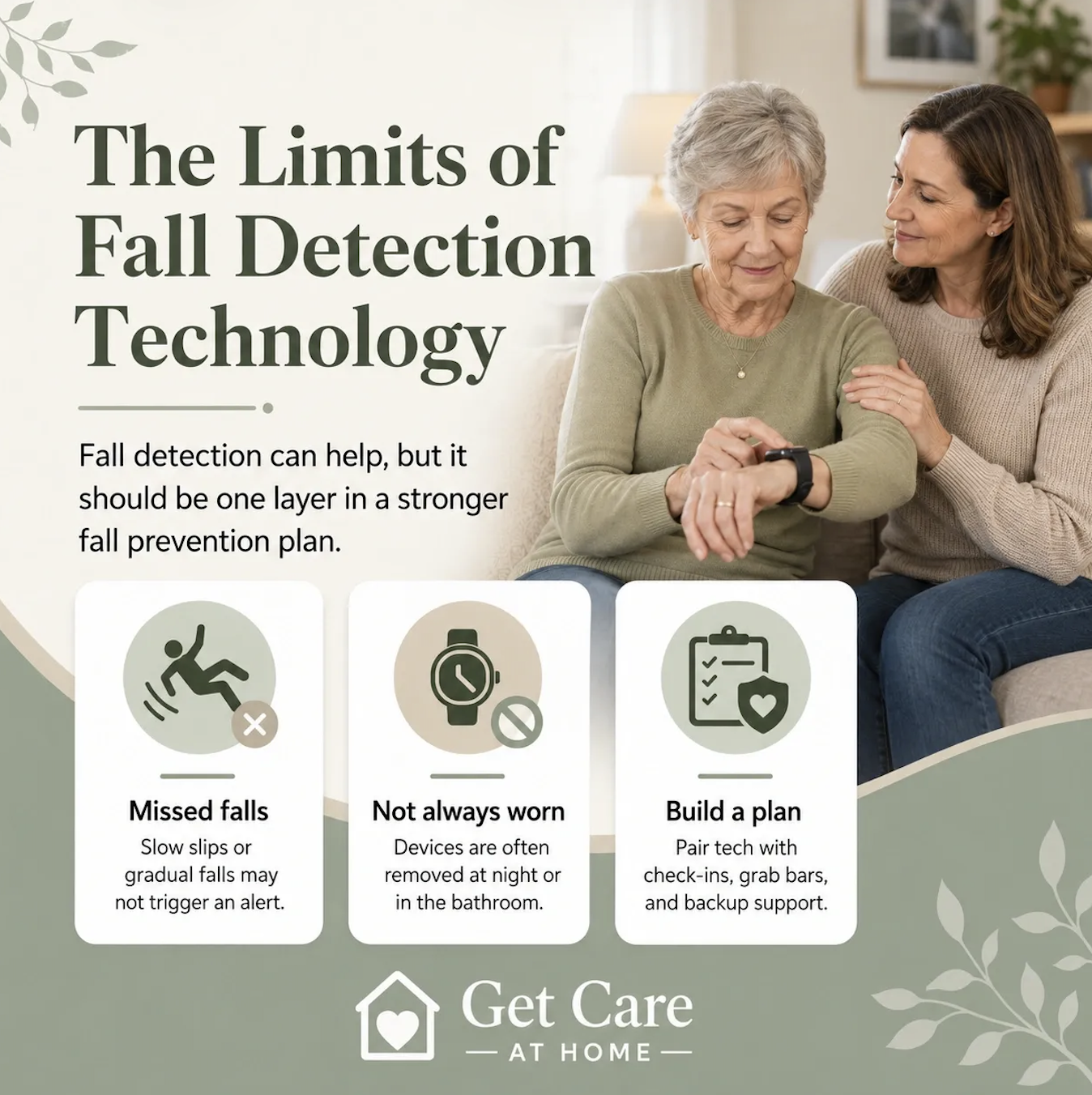
Slow-motion falls: A person who slides gradually down a wall or lowers themselves to the floor won't generate the sharp acceleration spike algorithms are trained to detect. For someone with dementia who may lose their footing slowly or brace themselves differently, this gap is more common than families expect.
Device not worn: Studies consistently find that people are less likely to wear their device at night and in the bathroom — exactly when and where falls are most common. For a parent with dementia, remembering to put it on every single morning is its own daily challenge. Caregivers often overestimate how reliably this happens.
False positives: Frequent false alarms cause users to disable alerts or stop wearing the device altogether. For someone with dementia who doesn't fully understand what the alert means, canceling a real one becomes a real risk.
Connectivity gaps: Alerts require a cellular or Wi-Fi connection. Older homes with thick walls, basements, or inconsistent rural service can interrupt the signal needed to call for help — often in the rooms where your loved one spends the most time.
Loss of consciousness: If someone falls and immediately loses consciousness, they cannot cancel a false alarm — but they also may not be able to confirm a real one or press a help button. Devices that require active user response have a built-in gap that is especially relevant for people with dementia.
Algorithm bias: Most fall detection algorithms were developed using data from younger, more mobile adults. They may be less accurate for people who use mobility aids, have tremors, or move with the shuffling gait that is common in mid-to-late stage dementia. In other words, the device may have been designed for someone very different from your parent.
What this means for your family
None of this is an argument against fall detection. It is an argument for treating it as one layer in a safety plan rather than the whole plan — and for resisting the exhale that comes when the box is checked and the device is on the wrist.
The families who fare best are usually the ones who treated fall detection as a conversation starter, not a conversation ender. They also installed grab bars, established a consistent check-in routine, and talked honestly with their parent about what they would want if something happened. They didn't stop watching just because the watch was watching too.
If your parent has dementia and is living at home, fall risk doesn't exist in isolation. It lives alongside medication management, behavioral changes, nighttime wandering, and the hundred small decisions that shift as the disease progresses. A device can monitor a wrist. It cannot see the whole picture.
That is what a trained, specialized caregiver can do.
Margaret eventually added a wall-mounted sensor for her bathroom and established a daily check-in call with her daughter. The fall detection watch stayed on her wrist. But the family's relationship to it changed. They stopped trusting it to handle everything. That shift — more than the technology itself — is what made her safer.
If you're caring for a parent with Alzheimer's or dementia in Sacramento, Citrus Heights, Roseville, or Placer County and you're trying to build a plan that actually holds, we'd love to talk.
Get Care at Home provides specialized in-home Alzheimer's and dementia behavioral care for families who need more than a device — and more than a generalist.